 admin
admin How to Care for Aggressive Fish in Ornamental Fish Care: Tank Setup
You’ve fallen for the intense beauty of an Oscar, the dramatic flair of a Betta, or the commanding presence of a Jack Dempsey. But now, their territorial chasing, fin-nipping, or outright bullying is turning your dream aquarium into a stressful battleground. This frustration is the most common pain point for aquarists venturing into the world of aggressive species. The secret to success doesn’t lie in hoping for a peaceful personality; it hinges entirely on intentional, strategic tank setup. A properly arranged environment is the cornerstone of how to care for aggressive fish, transforming tension into a stable, thriving display.
Understanding that aggression is often a natural behavior—not a flaw—is the first step. In the wild, fish are aggressive to secure food, shelter, and breeding rights. Our job is to use tank design to mitigate these triggers. This guide will provide a clear, step-by-step framework for creating an aquarium that manages aggression through territory, sightlines, and security.
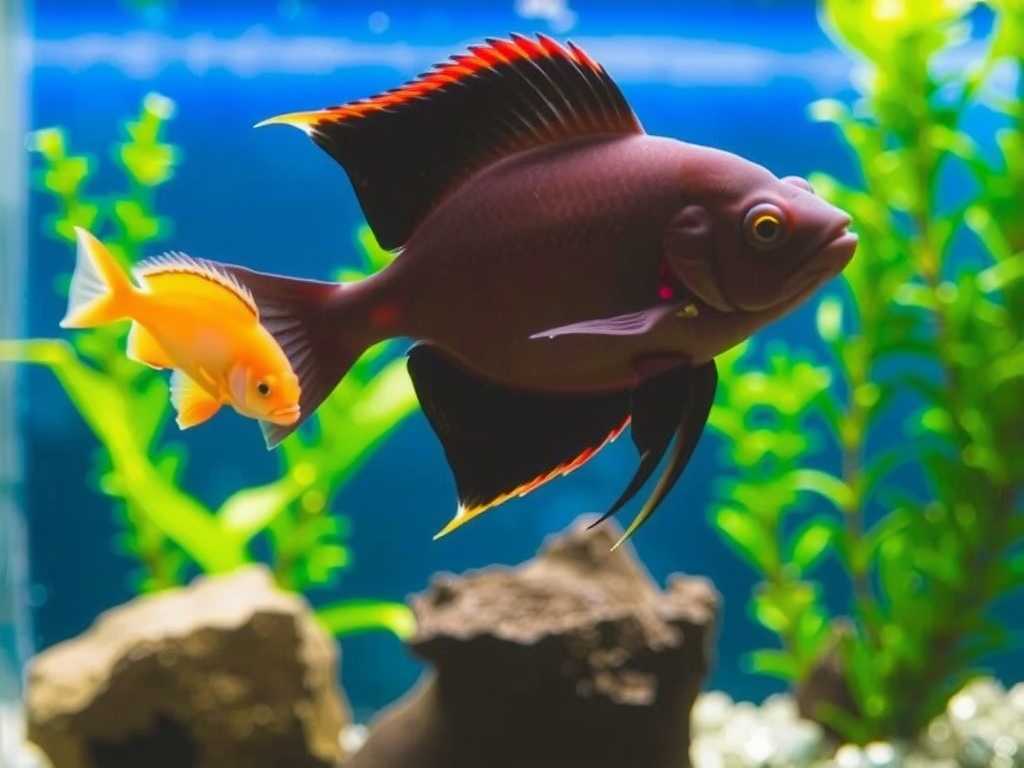
The Foundational Principle: Size and Shape Are Everything
The single most critical factor in aggressive fish tank setup is volume. A small tank concentrates conflict, offering no escape and constant confrontation. For most aggressive freshwater cichlids, a 55-gallon tank is a starting point for a pair or small group of a single species. Large South American cichlids like Oscars or Jaguars often require 75 to 125 gallons or more as adults.
Beyond gallons, consider footprint—the length and width of the tank. A long, wide tank (e.g., a 75-gallon with its 48-inch length) is vastly superior to a tall, narrow tank of the same volume. Horizontal swimming space allows for the establishment of distinct territories, which is the primary tool for reducing direct conflict. Research published in the Journal of Applied Animal Welfare Science emphasizes that environmental complexity, enabled by sufficient space, significantly reduces aggression in captive fish by allowing for behavioral choice and retreat.
Strategic Layout: Breaking the Line of Sight
In an aggressive species aquarium, what fish can’t see is as important as what they can. Continuous open sightlines allow a dominant fish to patrol and harass all tankmates relentlessly. Your goal is to create a visually divided landscape.
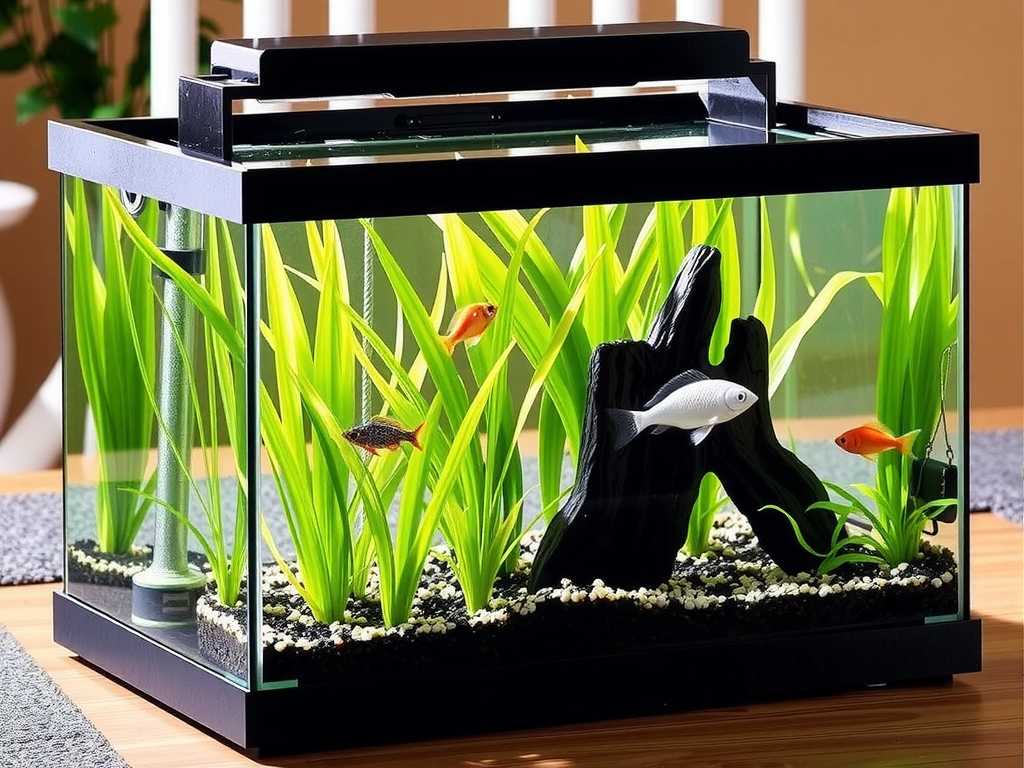
- Hardscape as Walls: Use large rocks, driftwood, and robust aquarium decorations to create physical barriers. Arrange these elements to form multiple, separate territories across the tank. A central, large piece of driftwood with sprawling branches can effectively split the aquarium into two or more zones.
- Dense, Tactical Planting: Live plants are not just decorative; they are functional tools. Plant tall, sturdy species like Amazon Swords, Vallisneria, or Java Fern in dense thickets. These plant clusters provide hiding places and visual breaks. For fish that dig, such as many cichlids, anchor plants well or use potted plants. As aquascaping expert Takashi Amano noted, plants can guide the flow and movement within an aquarium, a principle that directly applies to managing fish traffic and interaction.
- Territorial Anchors: Most aggressive fish claim a specific cave, pot, or rock formation as their "home." Provide multiple, suitable hiding spots before introducing fish. This prevents competition for a single desirable shelter. Ensure these caves have more than one entrance/exit to prevent fish from being trapped.
Engineering the Environment: Filtration, Flow, and Substrate
The technical setup must support the bioload of these typically messy eaters and reinforce the tank’s stability.
- Over-Filtration: Aggressive fish produce significant waste, which degrades water quality and increases stress—a major aggression amplifier. Employ a filtration system rated for at least 1.5 to 2 times the actual tank volume. Canister filters are often ideal for their high capacity and ability to house chemical media. Consistent, pristine water parameters are non-negotiable.
- Current and Surface Agitation: Use powerheads or wavemakers to create gentle to moderate water flow. This can disrupt rigid territorial boundaries by encouraging movement and preventing a fish from statically holding a single spot. Good surface agitation also ensures excellent oxygenation, which is crucial for high-metabolism species.
- Appropriate Substrate: Choose a substrate that suits the fish’s natural behavior. Sand is excellent for digging cichlids, allowing them to express natural foraging and territorial shaping. Larger, smooth gravel can work for others. The color can also play a role; a darker substrate often helps fish feel more secure and displays their colors better, potentially reducing skittishness.
The Hierarchy of Tankmates: Careful Curation
This is where managing aggressive community fish becomes an art. The "aggressive community" is a misnomer if you imagine mixing passive and aggressive species. Instead, it involves carefully selecting tankmates that can coexist through balance of power and behavior.
- The Dither Fish Strategy: Fast, schooling fish that occupy the upper water column (like some robust Tetras or Silver Dollars) can actually reduce tension among bottom-dwelling aggressive fish. Their presence signals that the environment is safe, distracting territorial species from fixating solely on each other. They must be too fast to catch and large enough not to be seen as food.
- Creating Balance, Not War: Avoid pairing two hyper-territorial fish of similar size and color. Instead, consider fish with different territorial focuses—one that claims caves and another that stays near the surface. Always have a backup plan (a quarantine tank) ready to separate fish if relentless aggression occurs, regardless of setup.
- The Single-Species Tank: Often the most successful approach for highly aggressive fish is a species-only tank or a bonded pair. This removes the unpredictability of interspecies conflict and allows you to tailor the environment perfectly to one fish’s needs.
Maintenance Routines for a Stable Hierarchy
Your work isn’t done after setup. Maintenance must be performed in a way that minimizes disruption to established territories.
- Feeding Zones: Establish multiple feeding spots at opposite ends of the tank. This ensures subordinate fish have access to food without having to cross the dominant fish’s core territory. Using sinking and floating foods simultaneously can also spread out the feeding activity.
- Rearranging with Caution: While a full rescape can temporarily reset territories and break up aggression, it also causes significant stress. If you must rearrange, do so infrequently and consider moving the fish to a holding bucket during the process to disrupt their spatial memory more effectively.
Frequently Asked Questions
Can I keep aggressive fish with peaceful community fish? This is strongly discouraged. Peaceful fish will live in constant stress, hide incessantly, and likely become targets for fin-nipping or predation. It is an unfair and unsustainable combination that rarely ends well.
How many aggressive fish can I put in one tank? It is not about a number, but about providing enough territory for each. For many cichlids, a single pair or a group large enough to disperse aggression (so one fish cannot target all others) can work. Overstocking is risky and requires expert-level filtration and maintenance; understocking with ample space is a far safer strategy for beginners.
My fish was fine for months, but now it’s suddenly aggressive. Why? Sudden aggression is often a symptom of an underlying problem. The most common triggers are poor water quality, inadequate feeding, the onset of sexual maturity, or illness. Test your water parameters immediately, ensure a varied, high-quality diet, and observe the fish closely for signs of disease. An environmental stressor is almost always the root cause.
Creating a thriving aquarium for aggressive fish is one of the most rewarding challenges in the hobby. It moves beyond simple decoration into the realm of behavioral ecology and environmental design. By prioritizing space, strategically breaking lines of sight, and selecting tankmates with purpose, you build more than just a tank—you create a structured ecosystem that channels natural behaviors into a dynamic yet harmonious display. Success is measured not by the absence of any interaction, but by the presence of a stable balance where all inhabitants can exhibit their natural behaviors safely.
发表评论